
Prediction markets: betting on memes, elections and coin prices
Will this happen or not? Prediction markets turn questions into prices, and since 2024 they have become one of the busiest corners of crypto. Here is how they work.
Some people bet on football. Others bet on whether a meme coin will hit a certain price by Friday, or who will win an election. Prediction markets let them do exactly that, and the prices they produce have become a news source of their own.
Prices as probabilities
A prediction market lists a question with a yes or no answer. Shares in "yes" pay one dollar if the event happens and nothing if it does not. If "yes" trades at 30 cents, the market is saying there is roughly a 30 percent chance. Traders who think the real chance is higher buy; those who think it is lower sell. The price moves until the crowd roughly agrees.
From Iowa to the blockchain
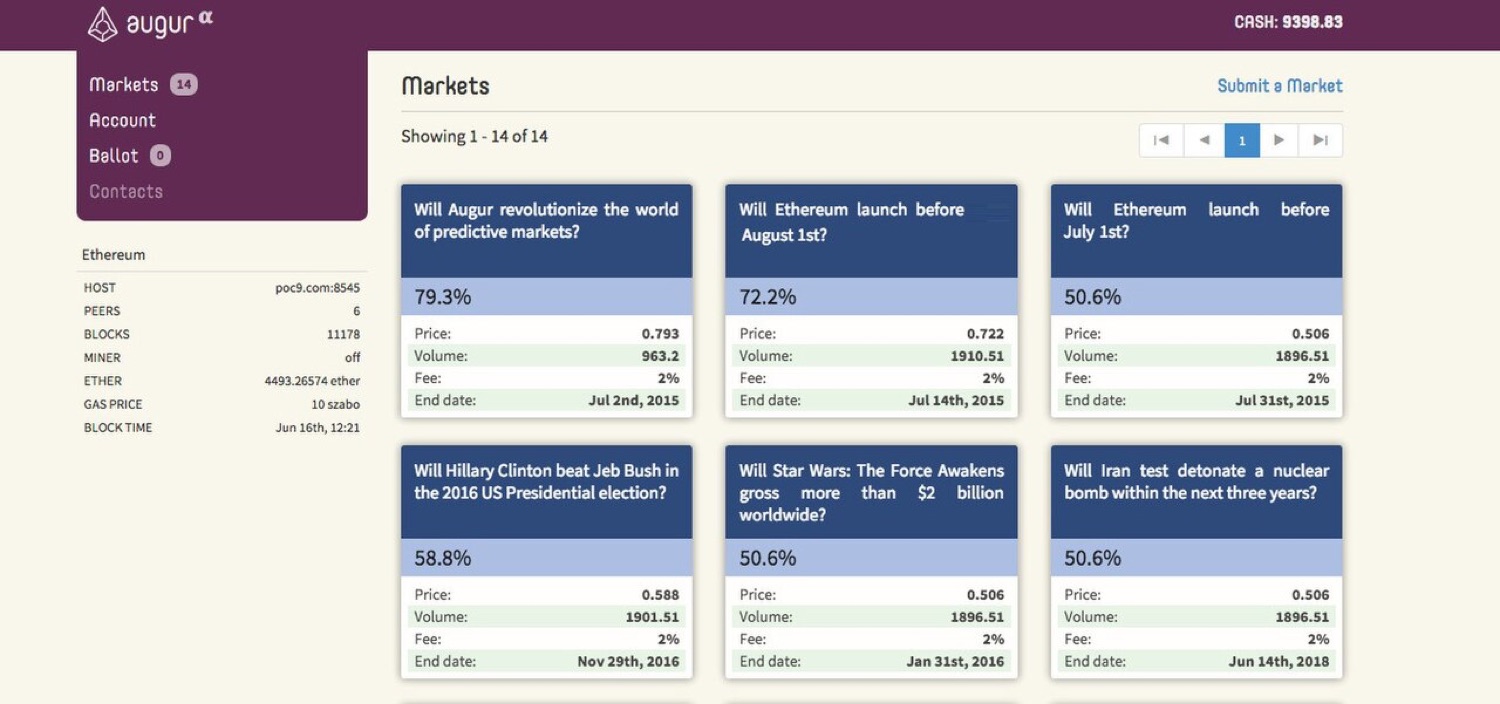
The idea is not new. Academic markets on elections have run for decades, and economists have long argued that markets can aggregate scattered information well. Crypto brought the idea to a global audience. Augur launched on Ethereum in 2018 as a decentralised prediction market; our photo shows its interface. Later platforms grew much bigger. During the 2024 US presidential election, crypto-based prediction markets handled billions of dollars in bets and were quoted in mainstream news. In the United States, a regulated exchange also won the right to list election contracts after a court case.
What people bet on
- Elections and political events.
- Sports results and awards.
- Crypto prices, including meme-coin targets and exchange listings.
- Pop culture: films, music charts, celebrity news.
Betting or trading?
That question is mostly legal. Some regulators treat prediction markets as financial derivatives, others as gambling, and the answer differs by country. For players, the experience is a mix of both: you take a position on an outcome, the price moves as news arrives, and you can sell before the result.
Why meme-coin fans love them
Meme coins and prediction markets share an audience that loves fast-moving stories and quick decisions. A market on whether a dog token will double this week is a meme, a bet and a news headline at the same time. It even has an advantage over the coin itself: the odds are visible. Compare that with the hidden odds of a token in meme coin or roulette wheel, or meet the animals in the meme-coin zoo.
The wisdom and madness of crowds
Prediction markets are often accurate, but not always. Thin markets can be pushed around by a few big traders, and crowds can share the same blind spots. Treat the price as a useful opinion, not a prophecy.