
The Great Stink of 1858: when London's river forced a revolution
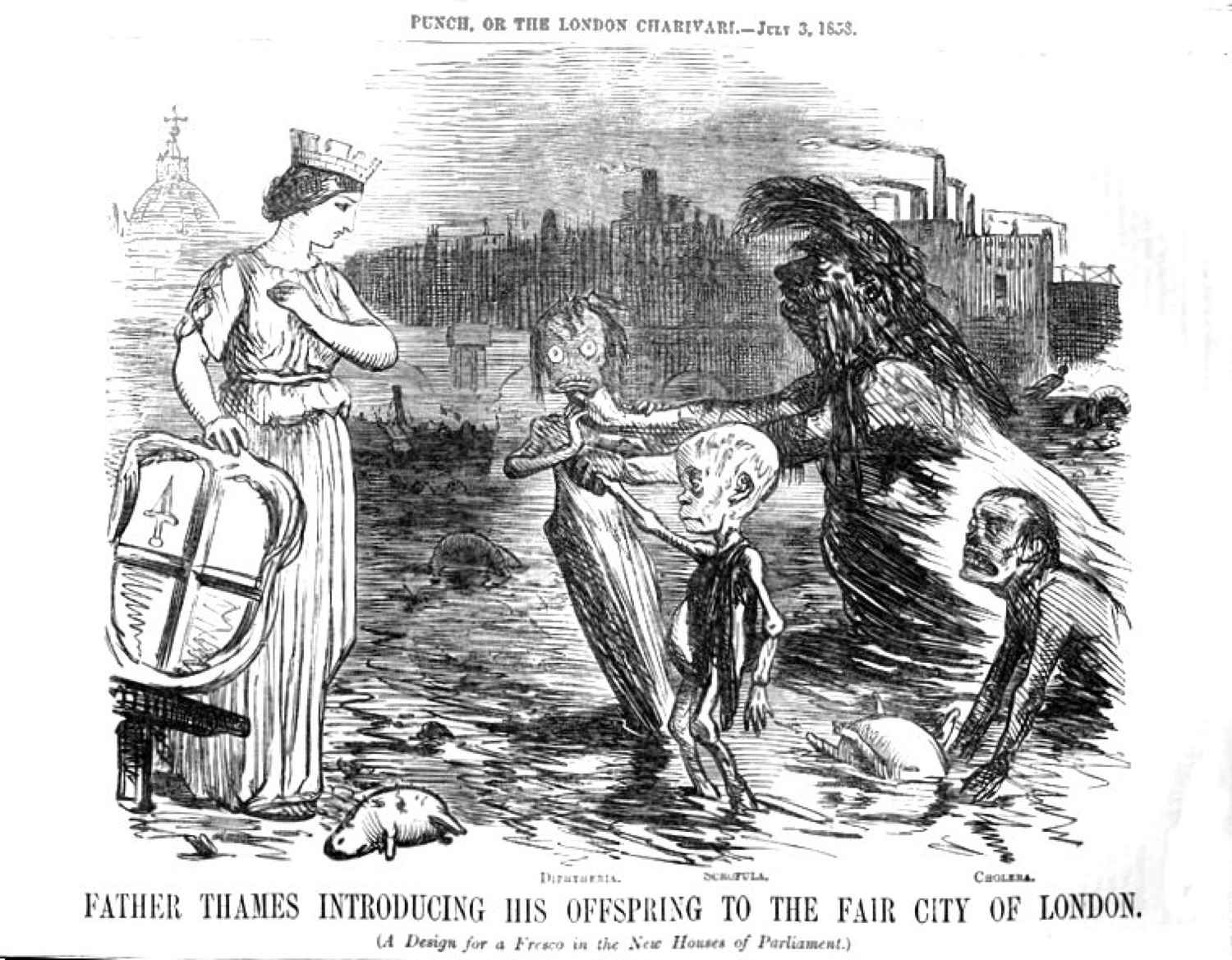
In the hot summer of 1858 the Thames smelled so bad that Parliament could barely sit. The result was one of the greatest engineering projects of the Victorian age.
In the summer of 1858 London was the largest city in the world, and its main sewer was the River Thames. Waste from millions of people, along with the run-off from new flushing toilets, poured straight into the river. Then came a long spell of hot weather, and the river began to cook.
A smell that reached Parliament
The newspapers called it the Great Stink. The Houses of Parliament sit right on the river, and members found the smell unbearable. Curtains soaked in chloride of lime were hung at the windows in an attempt to block it, and there was talk of moving Parliament out of London. Satirical magazines had a field day; the cartoon above, from Punch, shows Father Thames presenting his sickly children, labelled with the diseases of the day, to the city.
Many people at the time believed that disease spread through bad air, the so-called miasma theory. They were wrong about the mechanism, since cholera spreads through contaminated water, but right that the river was a public health disaster. The physician John Snow had already traced a cholera outbreak to a single water pump in Soho in 1854, though his ideas were slow to win acceptance.
Bazalgette's sewers
Within weeks, Parliament passed legislation to fund a new drainage system and gave the job to Joseph Bazalgette, chief engineer of the Metropolitan Board of Works. His plan was bold: huge intercepting sewers running parallel to the river would catch the waste before it reached the Thames and carry it east, downstream of the city.
- Around 80 miles of main intercepting sewers and well over 1,000 miles of street sewers were built, mostly between 1859 and the mid-1870s.
- Grand pumping stations such as Crossness and Abbey Mills lifted the sewage, housed in buildings so ornate they are called cathedrals of sewage.
- The Victoria Embankment was built partly to hold a main sewer, along with an underground railway line.
Bazalgette famously made his pipes bigger than his calculations required, guessing the city would grow. He was right, and much of his system still works today.
Victorian London's other clean-up
The same decade saw another kind of tidying. The Betting Act of 1853 shut down the betting houses that had sprung up across London, pushing wagering back to racecourses and street corners. Victorian reformers liked to clean up both the drains and the bookmakers, with very different degrees of success: the sewers lasted, while betting simply moved somewhere else.
Why it still matters
The Great Stink is a reminder that infrastructure is usually built only after a crisis becomes impossible to ignore. London's newest response, a super-sewer under the Thames completed in the 2020s, follows the same logic as Bazalgette's: build big, and build for the future. Bad smells, it turns out, are excellent motivators.